2026.05.08
Minimum Lovable Character
Every character in Found is built on something I’ve started calling the Minimum Viable Character, or MVC for short.
The concept sounds unintentional, uncared for, or even unrefined, but it isn’t. The MVC isn’t about doing less. It’s about leaving room for the player to bring their own relationships into the game. When a character is underspecified, the player reaches for someone they already know – a friend, a parent, a person from their own life who fits the shape. That substitution is doing enormous emotional work, and the character becomes personal in a way that detailed design actively prevents.

What MVC requires is precision in the right things. My characters have no mouths or noses or ears, only eyes. That’s a deliberate trade-off: you lose micro-expression entirely, which means the uncanny valley doesn’t open up, and you gain something more interesting. Feeling has to come through the whole body. A tilt of the head or a shrug or even stillness. This is how we actually read each other in real life, and it translates surprisingly well to a small figure on a screen.
Age works similarly. I have adults, children, and babies… and that’s it. Beyond those broad categories, age only enters through dialogue. A character isn’t visually coded as old or young or world-weary or naive. Whatever those things become, they emerge from what they say and how they say it. This sidesteps a lot of shorthand, and it opens up characters who might otherwise be flattened before the player even speaks to them.
What does visually distinguish characters is culture. There is no skintone, but eye color, hair color, outfit palette, and style all function as cultural markers. All telling the player something about where a character is from and where they’ve ended up. It’s not subtle. But it works precisely because it cuts against how we usually scan people. The dissonance is the point. You notice something you wouldn’t normally notice, and then you start asking why.
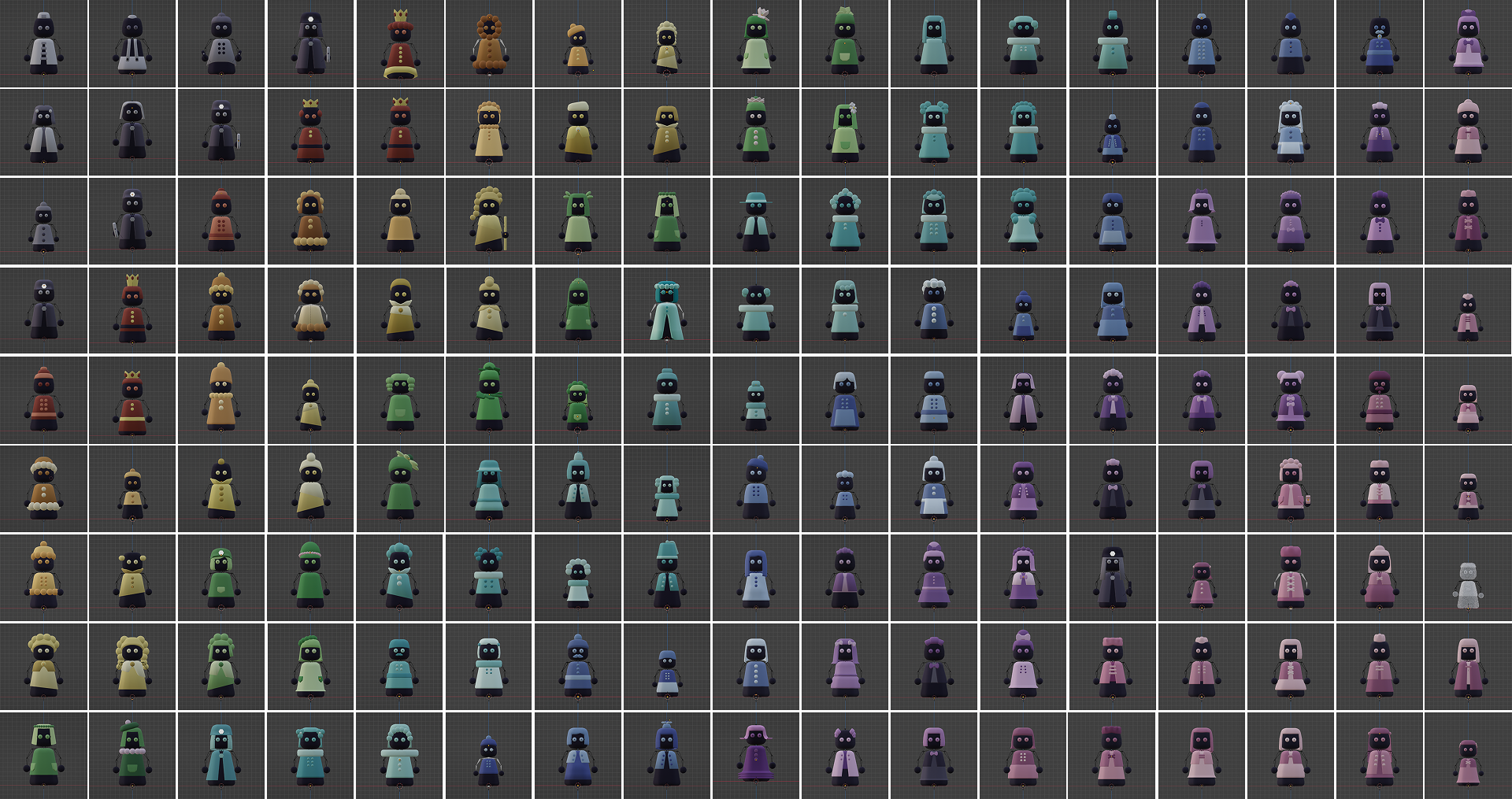
There’s something I keep coming back to in all of this: how much our imaginations will do if you give them the right kind of gap. The MVC works because the absence is structured. The missing detail is in the right place. Fill in too much, and the player stops participating in character definition. Leave too much, and they have nothing to hold onto.
Which is maybe why “minimum viable” is the wrong framing. Viable sets the floor. What I’m actually after is minimum lovable – the least a character needs to be before a player can make them their own.